
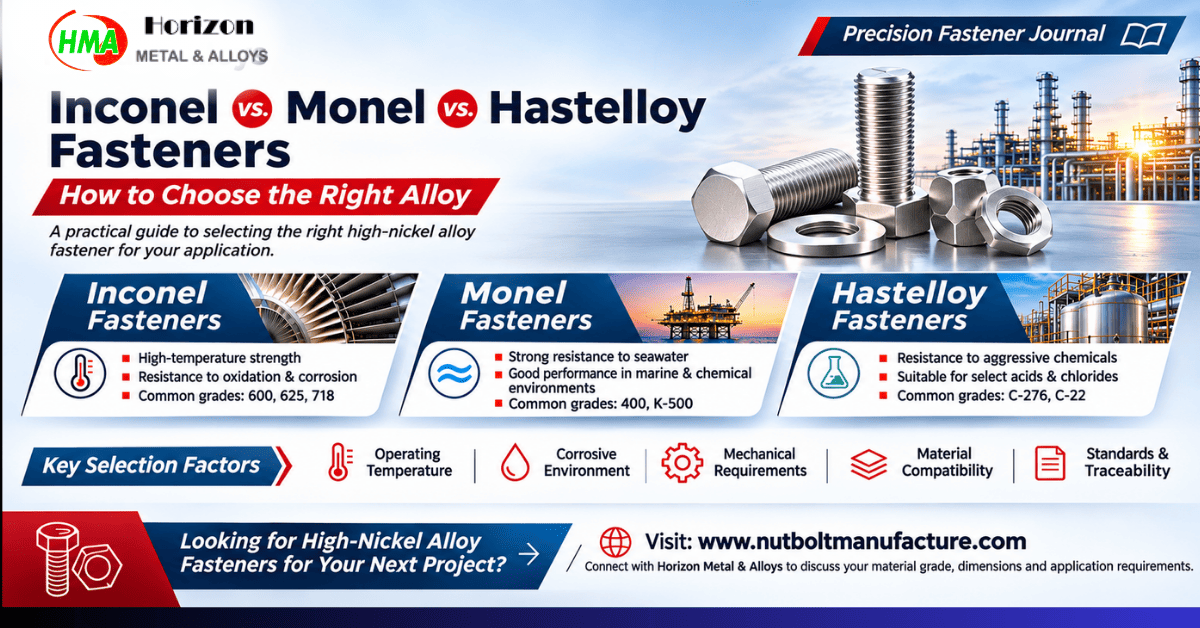
Inconel vs. Monel vs. Hastelloy Fasteners: How to Choose the Right Alloy Home – Blog Inconel vs. Monel vs. Hastelloy Fasteners: How to Choose the Right Alloy Selecting the right high-nickel alloy fastener is essential for reliability, corrosion resistance and long-term performance in demanding industrial environments. n industries such as oil and gas, petrochemicals, chemical processing and marine engineering, fasteners are more than simple connecting components. They must withstand specific combinations of temperature, pressure, corrosive media and mechanical stress. Among the materials considered for demanding applications, Inconel, Monel and Hastelloy are well-known nickel-based alloy families. However, each offers different properties, and choosing the right one depends on the operating environment and the specific alloy grade. Inconel vs. Monel vs. Hastelloy Fasteners: How to Choose the Right Alloy, we explore their key differences and the factors to consider when selecting industrial fasteners. Nickel Alloy Bolts and Nuts, Industrial Fasteners Manufacturer, Corrosion Resistant Fasteners, High Temperature Fasteners, Nickel Alloy Stud Bolts, Nickel Alloy Nuts Manufacturer, Industrial Fasteners Supplier, India. What Are Inconel Fasteners? Inconel is a family of nickel-based alloys commonly selected for applications requiring high-temperature strength and resistance to oxidation or corrosion, depending on the grade. Key characteristics Good strength retention at elevated temperatures for suitable grades. Resistance to oxidation and certain aggressive environments. Availability in grades designed for demanding thermal and mechanical conditions. Common applications Gas turbines and power generation equipment. Aerospace and high-temperature systems. Oil and gas processing equipment. Industrial equipment exposed to elevated temperatures. Popular grades: Inconel 600, 625 and 718. For example, Inconel 625 is often considered where corrosion resistance and strength are important, while Inconel 718 is known for its high strength in demanding mechanical applications. 2. What Are Monel Fasteners? Monel is a nickel-copper alloy family known for its resistance to seawater and certain corrosive environments. Its suitability depends on the grade and the specific service conditions. Key characteristics Strong resistance to seawater in many applications. Good performance in selected marine and chemical environments. Useful mechanical properties for demanding industrial components. Common applications Marine equipment and offshore installations. Pumps, valves and fluid-handling systems. Selected chemical-processing equipment. Components exposed to suitable saline environments. Popular grades: Monel 400 and Monel K-500. Monel 400 is widely used for corrosion resistance in suitable environments. Monel K-500 offers higher strength and hardness through age hardening, making it appropriate for applications where its mechanical properties are required. 3. What Are Hastelloy Fasteners? Hastelloy is a family of nickel-based alloys developed for demanding corrosive environments. Certain grades are particularly useful in chemical processing, where resistance to specific acids and other aggressive media is critical. Key characteristics Resistance to a range of aggressive chemical environments, depending on grade. Potential suitability for selected acids and chloride-containing media. Options designed for specialised chemical-processing requirements. Common applications Chemical and pharmaceutical processing plants. Reactors, vessels, pumps and valves. Pollution-control equipment. Industrial systems handling aggressive process chemicals. Popular grades: Hastelloy C-276 and C-22. Both grades are used in demanding corrosion environments, but their relative performance depends on the chemical composition, concentration, temperature and operating conditions. 4. Inconel vs. Monel vs. Hastelloy: Key Differences Comparison factor Inconel Monel Hastelloy Alloy family Nickel-based alloys, often nickel-chromium Nickel-copper Nickel-based alloys, often nickel-molybdenum or nickel-chromium-molybdenum Main selection considerations High-temperature strength, oxidation and corrosion resistance Seawater and selected corrosive environments Resistance to specific aggressive chemicals Typical applications High-temperature equipment, power generation, oil and gas Marine equipment, pumps and valves Chemical processing, reactors and industrial process equipment Example grades 600, 625, 718 400, K-500 C-276, C-22 Best choice depends on Temperature, mechanical loads and environment Fluid chemistry, temperature and strength requirements Chemical exposure, temperature and corrosion mechanism Important: These are general comparisons of alloy families, not universal performance guarantees. Actual suitability must be verified for the exact grade and operating conditions. What Are High Nickel Fasteners? 5. How to Choose the Right Alloy Fastener Before specifying Inconel, Monel or Hastelloy fasteners, consider these five factors. A. Operating temperature Determine the normal operating temperature, peak temperature and any temperature cycling. High-temperature strength and oxidation resistance vary between grades. B. Corrosive environment Identify the actual media, including acids, chlorides, seawater, gases and possible contaminants. Concentration and temperature can significantly change corrosion behaviour. C. Mechanical requirements Review tensile strength, loading, vibration, fatigue, hardness and any applicable pressure-system requirements. A corrosion-resistant alloy is not automatically the best option for every mechanical application. D. Compatibility with connected materials Consider galvanic corrosion, thermal expansion, thread galling and the materials being joined. Correct installation procedures and compatible lubricants may also be important. E. Standards and traceability Confirm the required fastener specification, dimensions, thread form, mechanical properties, material certification and inspection requirements. Verify that the supplied grade meets the relevant project specification and applicable standards. 6. Common Mistakes to Avoid Choosing an alloy based only on its name or general reputation. Assuming every grade in an alloy family has identical properties. Selecting fasteners without reviewing the actual process chemistry. Overlooking thread galling, installation torque or material compatibility. Failing to verify material certificates and project-specific requirements. A technically appropriate fastener selection can help improve equipment reliability and reduce the risk of premature component failure. 7. Partner with Horizon Metal & Alloys Choosing industrial fasteners for challenging environments requires careful attention to alloy grade, application requirements and project specifications. Horizon Metal & Alloys serves industrial requirements for high-nickel alloy fasteners, including Inconel, Monel and Hastelloy options, subject to grade and availability. Whether your application involves chemical processing, oil and gas, petrochemicals or other demanding industries, ensure your fastener selection is based on verified material requirements and operating conditions. Looking for high-nickel alloy fasteners for your next project? Visit: https://www.nutboltmanufacture.com/ Connect with Horizon Metal & Alloys to discuss your material grade, dimensions and application requirements. About Us | High Nickel Fasteners Manufacturer in India | Horizone Fasteners Horizone Fasteners is a leading High Nickel Fasteners Manufacturer in India, specializing in Stainless Steel Fasteners, Inconel, Monel, Hastelloy, Duplex, Super Duplex, Titanium, and Nickel Alloy Fasteners for India and Middle East countries. Most Recent Posts All Posts